
From the Third World
Published in "The Birthday Book - Ten Year Series: The Singapore Examination", edited by Ryan Kueh, Aaron Maniam and Cherie Lim Tseng
I arrived in Nairobi at 6:30AM on a July morning in 2023—into the chill of a surprising tropical winter. I carried with me a handful of useless Singapore dollars (none of the money changers at Jomo Kenyatta International Airport had ever seen Yusof Ishak), three suitcases of too-thin clothes, and some very confused ideas of Africa.
In this way the first few weeks were rocky, trying to find my feet in a country where I am the only Singaporean I know, where there is no Singaporean embassy, and where I am as strange to them as they are to me. I knew little beyond a gallery of stereotypes which reduce Africa to a poor, backward and exotic corner of our world. Hope—that I would learn and unlearn—had carried me here. But I also carried guilt, for knowing so little. I felt embarrassed that I had the audacity to complain about foreigners believing Singapore to be part of China, when I could hardly tell the difference between Nigeria and Nairobi.
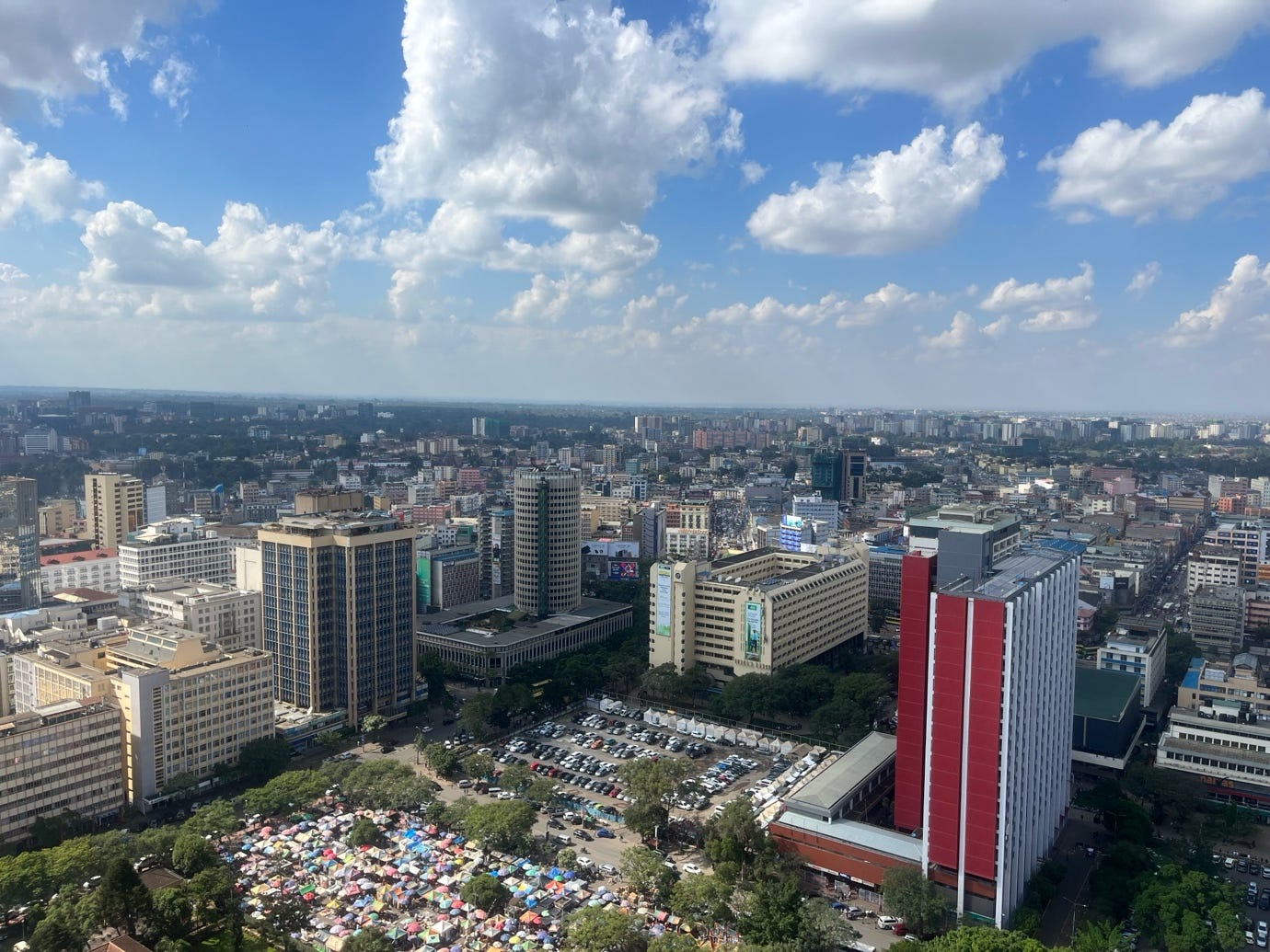
Watching Nairobi and the famous Maasai Market from the rooftop of the Kenyatta International Convention Centre (KICC).
Some Kenyans know us anyway, especially the boda-boda riders, who are first confused that I’m neither Chinese, Japanese nor Korean, then excited. They have seen us on TikTok, the city with the boat on top of three buildings. They’re baffled and amused that for all our “development”, we don’t have a “countryside” (But, where do you rear your cows?). Several taxi drivers cite the same statistical titbit to me: Did you know in 1960, Kenya’s GDP was higher than Singapore? I know they say it out of goodwill, hoping that this statement will connect with the muzungu [1] girl in their backseat. But the tragedy of the comparison—mixed with wonder and lament—is implicit.
So I learn about their ideas of us too, in the year I spend working with the United Nations on digital transformation and AI adoption in East Africa. Over the mandazis [2] and coffees in the office pantry, during the transitory ambles of walk-the-grounds and site visits, and on the sidelines of various conferences, I saw Singapore through the eyes of our counterparts. The Rwandans always remind me that they’re on their way to becoming the “Singapore of Africa”.[3] Similarly, as the Kenyans continue tinkering with eCitizen,[4] they are fascinated by SingPass and its seamless interoperability. In these and other areas —such as corruption-free governance, economic growth, education and talent development—we represent an aspirational model that emerged from unequal colonial structures around the same time that they did, a post-independence could-have-been.
Tell us more about Singapore, they’d urge, we want to learn. Amateurishly, I’d tell them as much as I knew from reading the Straits Times, from friends in GovTech, from my layman experiences as a citizen-beneficiary of Smart Nation 2.0. They’d tell me about the digital innovations emerging from the grassroots—like one entrepreneur who built East Africa’s largest online cattle-trading platform when he noticed that farmers didn’t have means to sell their cows online.[5]
You are lucky, a good friend and colleague said to me one day, that you have a good government that gets things done. Here, she lamented, we must help ourselves.
Yes—but—, I paused. The thought felt problematic to articulate. For must something not give, with a strong state? In my time in Kenya, I’d come to envy the collectives of activists, entrepreneurs, rights defenders, environmentalists, journalists and artists, among others, whose hunger to drive change in their countries never ceased to amaze me. In the sixty years of our country’s parallel lives,[6] Kenya’s civil society had matured far more than ours. Perhaps, for better or for worse, they had to grow to fill the bigger chasm between state and society.
Such conversations filled me as much as they vexed me—how interesting we have become to others, how much we have to share! But I was also haunted by this asymmetry: how much Africa wanted to learn from us, but less the other way around. It wasn’t easy to explain to friends and family why I’d decided to go. But why Africa? they’d ask, what do they even have to do with Singapore?
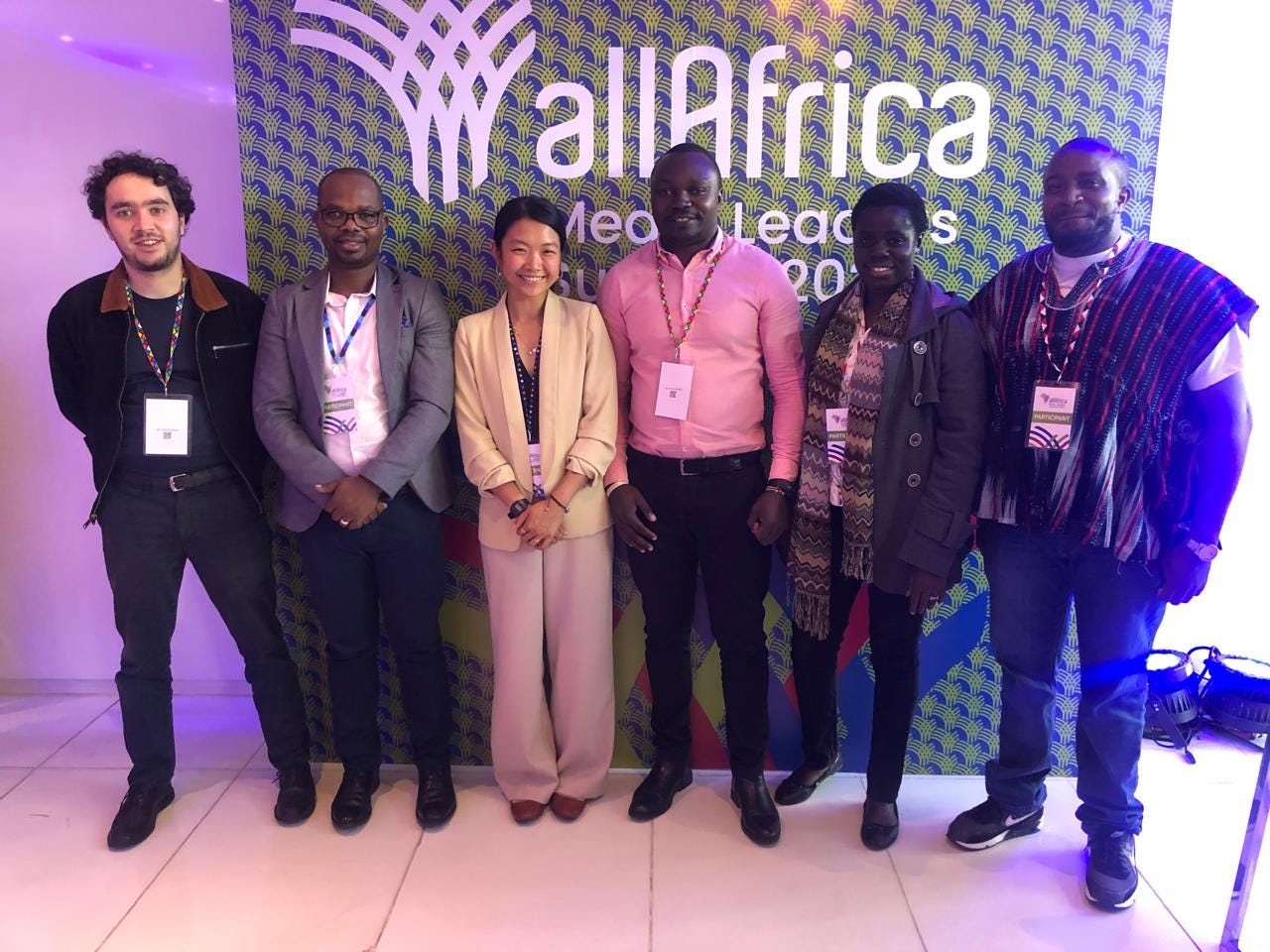
My colleagues and I after the 2024 allAfrica Media Leaders Summit, where journalists, editors, radio hosts, influencers and other media practitioners from around the continent gathered to discuss how the media can shape and reimagine narratives about Africa in a time of digital disruption and media transformation.
I suppose we came to learn about the “Third World”—and see ourselves beyond it—when the narrative of Singapore’s passage ‘From Third World to First’ emerged from Lee Kuan Yew’s titular memoir. As Philip Holden writes, the reinforcement of this development myth came to shape the Third World as a site of failure in our imaginations.[7] Standing in our space of apparent comfort and completion, it is easy to see ourselves as the “final form” of progress. But if by now we have accepted the corpus of refutes again developmental evolution, can we look elsewhere to learn, beyond the “developed” world?
Sixty years later, today, I’m afraid that we let ourselves become accustomed to that hollow feeling of restless aimlessness: that we have done all there is, that there is no where we can look to learn, and nowhere else to go. I’m wary of over-prioritising the calls for self-reflection, frequently at inflexion points like ours, to “look inwards”. I worry about the mindsets that national self-centeredness seeds—not so much the naïve stereotypes we carry about Africa or elsewhere, but apathy towards parts of world which do not bear obvious pragmatic interest to us.
The last thing I did in Nairobi before I returned home was to attend the first-ever East African Regional Summit on AI. Africa, proclaimed the ministerial leaders, urgently needed to harness AI to leapfrog the fourth industrial revolution, or risk lagging further behind. The atmosphere was part rivalrous, part collaborative. Countries were eager to showcase their report cards (nobody wants to be the “least developed country”). Until the South Sudanese delegate took the stage.
“South Sudan is far behind,” she said, addressing the 500 delegates across more than ten East African countries. “We do not have money. We do not have talent. We do not have compute. We do not have infrastructure.”
“But we have lots to learn,” she emphasised, “and we welcome everybody to help us learn.”
I still think about her and South Sudan often—a country just 14 years old and which is barely emerging from civil war. Their context is different, but in them there is something for us to learn too: this clarity of self, this hunger to grow, and sincere desire to learn from and listen to the world.
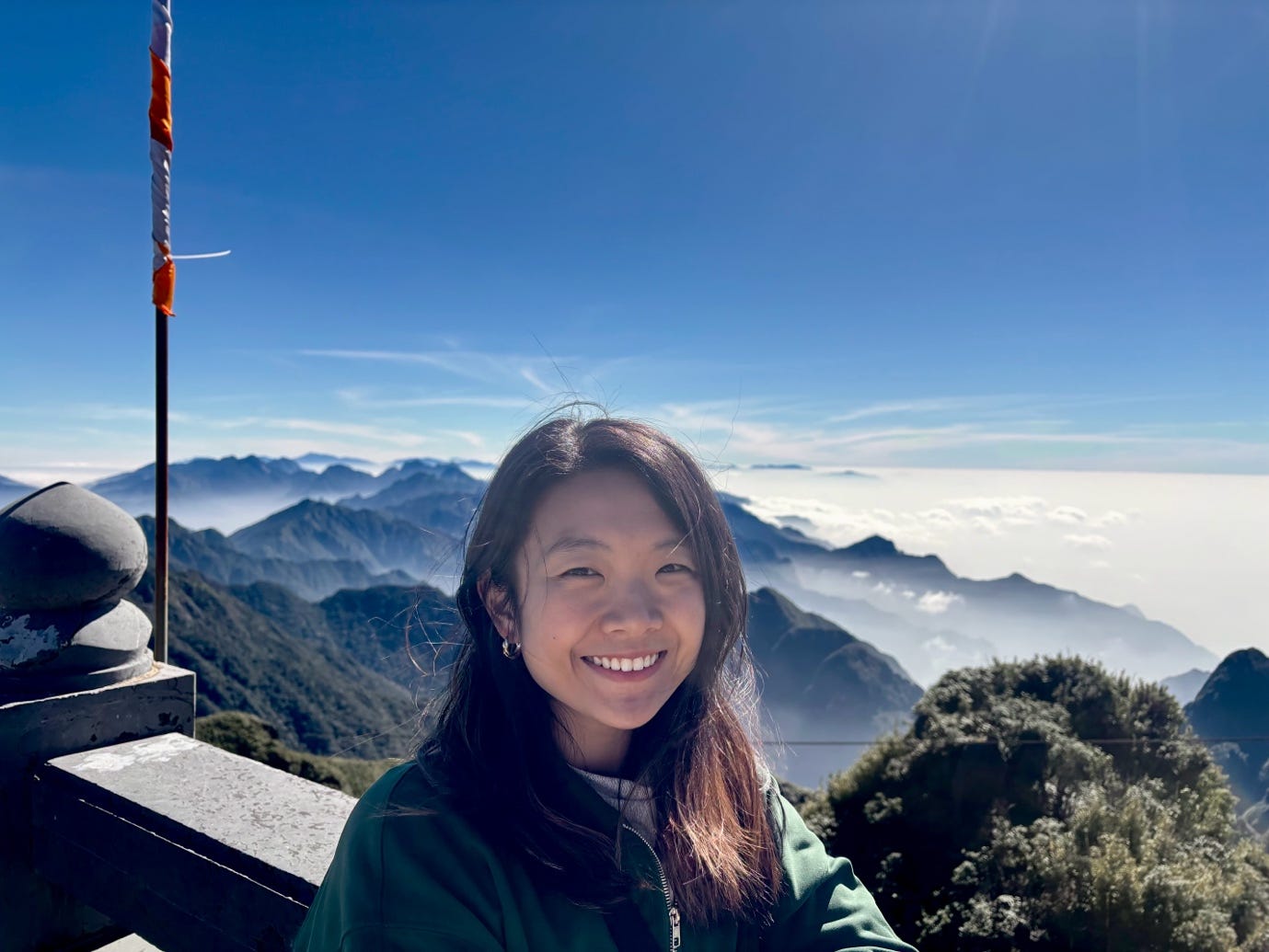
About the Author: Sharmaine Koh describes herself as a “historical journalist”, passionate about building just, equitable and inclusive institutions and (his)storytelling for peace. She spent a year working on documentary heritage preservation and digital transformation for sustainable development at the UNESCO Regional Office for Eastern Africa. She was educated at Yale and Tsinghua Universities, and hopes to return to Africa one day to work in peacebuilding and humanitarian aid. Link to The Birthday Book.
[1] A sweet, donut-like pastry commonly eaten for breakfast and tea in Kenya. It is a type of fried bread that originated on the Swahili coast.
[2] “Muzungu” is a Bantu word that is frequently used to refer to foreigners in Kenya. The term is also used in East, Central, and Southern Africa, including Tanzania, Malawi, Rwanda, Uganda, and Zambia.
[3] This narrative of Rwanda as the “Singapore of Africa” was first used and popularised by Rwandan President Kagame. Under Kagame, Rwanda’s development strategy has closely paralleled Singapore’s, including an emphasis on finance and services, as well as an emphasis on stability, tidiness and order. The country also aims to position itself as a gateway to trade and technology in the continent. See: Caryl, C. (2015, April 2). Africa’s Singapore Dream. Foreign Policy. https://foreignpolicy.com/2015/04/02/africas-singapore-dream-rwanda-kagame-lee-kuan-yew/
[4] Kenya’s eCitizen platform aims to simplify and enhance access to government services by unifying all government records on a digital portal. Citizens, non-Citizens and Business entities can now search, apply and pay for services online with one unique log-in account. See: https://accounts.ecitizen.go.ke/en
[5] Cowsoko, literally “Cow Shop” in Kiswahili, is East Africa’s largest online platform that connects farmers to farming information and cattle markets. It was founded by Kenyan entrepreneur Victor Otieno in 2015. See: https://www.cowsoko.co.ke/
[6] Kenya celebrated 60 years of independence in 2023, just two years before us.
[7] Holden, P. (2015). Questioning ‘From Third World to First’. In Chia, J. M., Loh, K. S. & Thum, P. Living with Myths in Singapore (pp. xx-xx). Ethos Books.
The observation about civic society maturity filling the state-society gap is incredibly perceptive. Singapore's efficiency came at the cost of what might be called democratic muscle atrophy. Spent time in Jakarta a while back and was struck by how engaged ordinary citizens were compared to back home. The question isnt just whether we can learn from elsewhere but if we still remember how to be curious about places that dont serve obvious economic interests.